
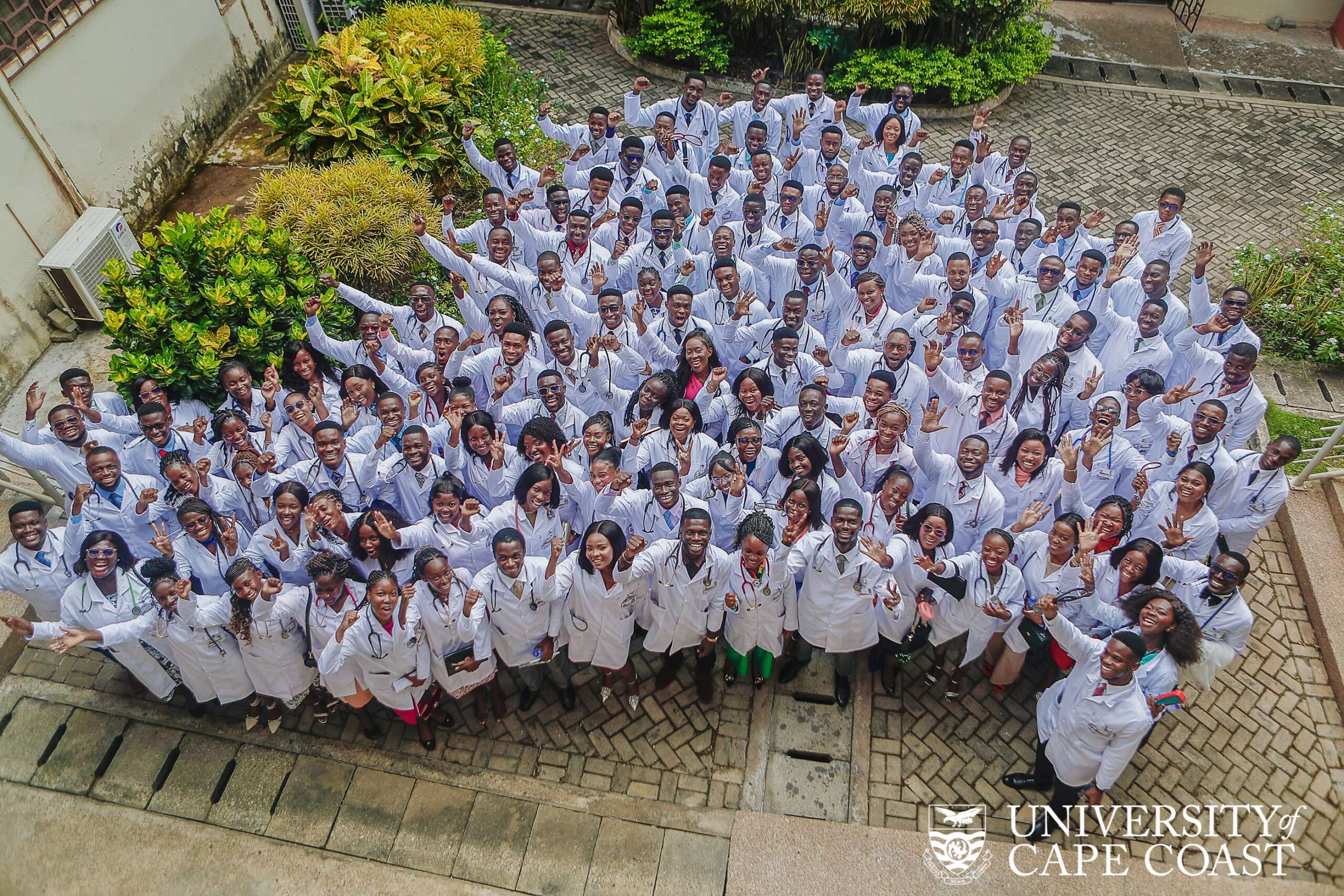
Become the doctor Ghana needs
The University of Cape Coast School of Medical Sciences trains doctors who are people centred, community oriented and research conscious. Patient simulation from your second year, not your fourth.
700+
doctors trained since 2013
6
years, two cycles
17
departments, three units
2008
first students matriculated
Latest news
- Prof. Dorcas Obiri-Yeboah assumes office as Provost of the College of Health and Allied SciencesProf. Dorcas Obiri-Yeboah of the Department of Microbiology and Immunology became Provost of the College of Health and Allied Sciences on 1 August 2026, succeeding Prof. Martins Ekor.
- Prof. Martins Ekor ranked among the world’s top 2% of scientistsProf. Martins Ekor of the Department of Pharmacology has been ranked among the top 2% of scientists worldwide in TOPSCINET’s 2026 single-year ranking.
- SimMan 3G Plus (Robot Patient) arrives at UCC Medical SchoolUCC Medical School receives its first mannequin, SimMan 3G Plus, enhancing hands-on training with realistic simulations for students.
Problem based learning from year two
Small groups. Real clinical problems. Students identify what they do not know and go and find it, supported by a dedicated Problem Based Learning unit across every department.
Medicine where people live
Community Based Experience and Service is a unit in its own right, not an elective. Every student spends structured periods working in Ghanaian communities, running outreaches and studying health at population level.
Practise before the patient
Our clinical skills facility includes SimMan 3G Plus, a high fidelity simulator that breathes, bleeds and deteriorates. Students manage emergencies and make mistakes without a patient paying for the lesson.
We started in 2008 with a different idea about how doctors should be trained
When the founding Dean reviewed the plan for this School in 2005, he sent it back. The curriculum needed rebuilding around the student, the community and the problem rather than the lecture.
That decision still shapes everything here. Our students work with patient simulation from second year. They spend weeks living and working in Central Region communities. They reason through cases in small groups rather than memorising lists.
In August 2013 the first forty two doctors graduated from this School and were sworn in by the Medical and Dental Council of Ghana. More than 700 have now qualified.